Skip to main content
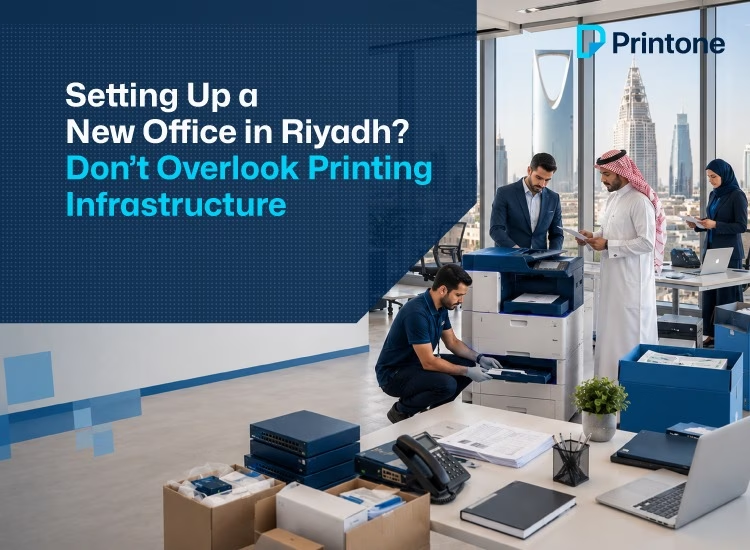

Opening a new office comes with a long checklist.
Finding the right location.
Hiring employees.
Setting up workstations.
Internet connectivity.
Access control.
Furniture.
Phones.
Meeting rooms.
Most of these are discussed weeks before the office opens.
Printing usually isn’t.
In many cases, the printer becomes an afterthought until the first day someone needs to print a contract, scan a signed document, or prepare a client proposal.
Then the question appears.
“Do we have a printer?”
And if the answer is yes, a second question often follows.
“Is it the right one?”
The Printer Often Becomes Everyone’s Printer
When a new office opens, a single printer is often expected to support multiple teams.
Administration uses it for employee documentation.
Finance relies on it for invoices and payment records.
Sales prints proposals and customer agreements.
Management uses it for reports and approvals.
The challenge isn’t the printer itself.
The challenge is how many people eventually depend on it.
What seems sufficient during setup can quickly become a bottleneck once the office reaches full operation.
The First Few Months Usually Reveal the Real Requirement
A new office rarely knows its exact printing requirements from day one.
The team is still growing.
Processes are still being established.
Departments are still defining workflows.
Print volumes often look very different six months after opening compared to the first week.
This is one reason many businesses in Riyadh avoid making large printing investments during the early stages of expansion.
Flexibility becomes more valuable than ownership.
Printing Requirements Vary More Than Businesses Expect
A consultancy opening a new branch may spend most of its time printing contracts, reports, and presentations.
A construction company may require A3 drawings, project documentation, and site records.
A logistics business may process delivery documents throughout the day.
A healthcare provider may focus heavily on scanning and document management.
The right printing environment depends less on industry labels and more on how documents move through the organization.
Scanning Often Becomes More Important Than Printing
When businesses discuss printers, they usually focus on printing speed.
In practice, many offices spend just as much time scanning.
Employee records.
Vendor agreements.
Signed contracts.
Invoices.
Customer documentation.
For some teams, scanning is used more frequently than printing.
That is why multifunction devices are becoming a common choice for new offices across Riyadh.
Support Matters More Than Specifications
During the buying process, it is easy to compare features.
Print speed.
Paper capacity.
Colour output.
Touchscreen size.
Those comparisons are useful.
But they rarely determine how satisfied a business will be twelve months later.
The real test comes when support is required.
A toner runs out unexpectedly.
A scan destination stops working.
A device requires servicing.
At that point, response time becomes more important than specifications.
Buying Isn’t the Only Option
Many businesses setting up new offices automatically assume they need to purchase equipment.
Sometimes that makes sense.
Sometimes it doesn’t.
A growing company may prefer to preserve capital for recruitment, operations, or expansion rather than allocate a large budget to office equipment from day one.
This is one reason printer rental continues to be a practical option for many organizations establishing new offices in Riyadh.
It provides access to business-grade printing equipment while allowing requirements to evolve as the office grows.
Think Beyond Day One
The question is not whether the printer will handle today’s workload.
Most printers can.
The better question is whether it will still support the office after six months, twelve months, or two years of growth.
The businesses that make the best decisions during office setup usually think beyond immediate requirements.
They consider future users.
Future departments.
Future document volumes.
And future support needs.
A printer may not be the first item discussed when opening a new office in Riyadh.
Yet it often becomes one of the most frequently used devices in the workplace.
The right printing setup helps documents move efficiently between departments, supports daily operations, and reduces unnecessary interruptions.
The wrong one often becomes noticeable only after the office is fully operational.
If you’re planning a new office in Riyadh, take a few minutes to think about printing infrastructure before the doors open.
It is much easier to get it right at the beginning than to fix it later.