Skip to main content
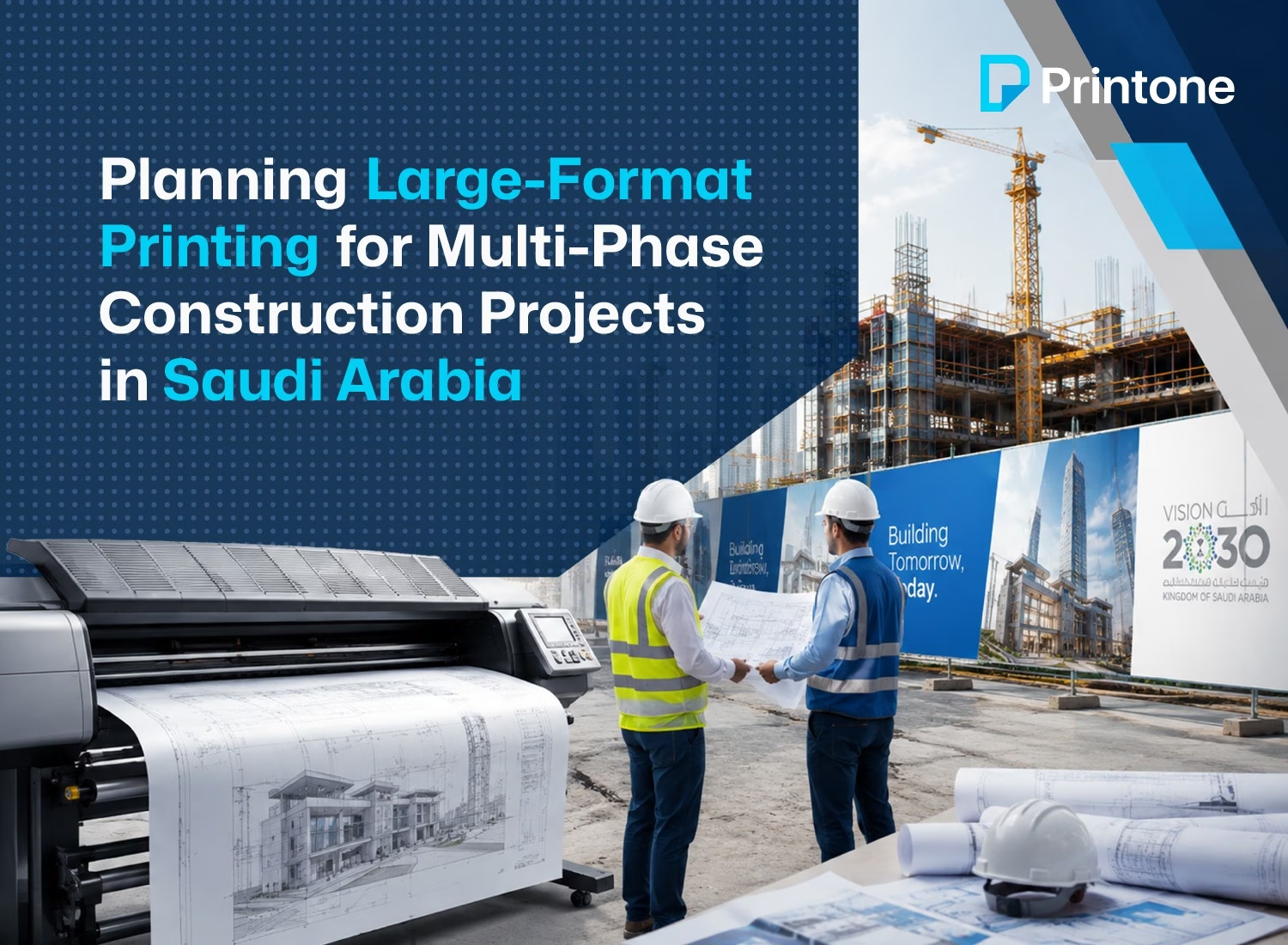

Construction projects rarely become more straightforward after the contract is awarded.
They become more demanding.
New drawing revisions arrive almost daily.
Consultants issue updated specifications.
Site teams request additional copies.
Subcontractors require approved plans.
Project managers work against tight submission deadlines.
Through every stage of that process, one thing remains constant.
Accurate technical drawings need to be available exactly when they’re needed.
That’s why many engineering consultants, contractors, project management companies, and infrastructure developers across Saudi Arabia are rethinking how they manage large-format printing.
The conversation isn’t simply about choosing a plotter.
It’s about ensuring project documentation never becomes the reason work slows down.
Large-Format Printing Should Be Planned Like Any Other Project Resource
When planning a construction project, businesses carefully allocate resources.
Engineers.
Equipment.
Materials.
Labour.
Budgets.
Timelines.
Yet large-format printing often receives attention only after the first deadline approaches.
A project team suddenly needs hundreds of drawings.
Existing office equipment can’t keep up.
Staff begin outsourcing urgent prints.
Engineers spend valuable time waiting instead of reviewing drawings.
The challenge isn’t the plotter.
The challenge is that printing was never planned as part of the project infrastructure.
Just as every site requires reliable equipment, every engineering office requires reliable access to technical drawings.
Every Project Phase Has Different Printing Requirements
One mistake businesses sometimes make is assuming their plotting requirements remain the same throughout the project.
In reality, they change significantly.
During tender preparation, print volumes may increase rapidly as multiple revisions are submitted within short timeframes.
Once construction begins, site teams regularly require updated structural, architectural, electrical and mechanical drawings.
Later, project documentation shifts towards inspection records, as-built drawings and final submissions.
The equipment that comfortably handles tender documentation may struggle once several project teams begin printing simultaneously.
That’s why an experienced plotter lease provider in Saudi Arabia doesn’t recommend equipment based only on today’s workload.
The recommendation considers where the project is heading.
Drawing Revisions Don’t Wait for Equipment Problems
Anyone involved in construction understands how quickly revisions move.
A consultant updates a structural detail.
An MEP drawing changes.
A municipality requests modifications.
A revised plan needs to reach the site before work continues.
When a plotter becomes unavailable during these moments, the impact goes far beyond delayed printing.
Site activities may pause.
Approvals may be delayed.
Project coordination becomes more difficult.
The cost isn’t measured by the repair invoice.
It’s measured by lost project time.
This is one reason many organisations choose plotter lease instead of relying on ageing equipment with uncertain support.
They’re investing in continuity.
Not simply another machine.
One Plotter Doesn’t Always Fit Every Project
One question we often ask businesses is simple.
“How many teams rely on this plotter today?”
The answer usually reveals much more than expected.
An architectural team may primarily produce presentation drawings.
Civil engineers generate detailed construction layouts.
MEP consultants require precise line accuracy.
Project managers print updated schedules and documentation.
Although everyone uses the same equipment, their priorities are different.
Choosing the right large-format printer isn’t simply about maximum paper width or print speed.
It’s about understanding how different departments work together throughout the project lifecycle.
The Best Plotter Recommendation Starts With Your Business
An experienced provider rarely begins by recommending a model.
The conversation starts with questions.
How many active projects are you currently managing?
Are additional projects expected this year?
Will new engineering teams be joining?
Do you print primarily CAD drawings or colour presentation boards?
How many users share the device each day?
Will drawings be produced only from head office, or will site offices also require printing?
These discussions usually determine the right solution far more accurately than comparing product brochures.
Because every engineering office operates differently.
Supporting Growth Without Interrupting Projects
Saudi Arabia continues to deliver some of the region’s largest infrastructure, industrial and commercial developments.
For engineering companies, that often means rapid business growth.
New clients.
Additional projects.
Larger teams.
Higher document volumes.
The challenge is that printing requirements grow just as quickly.
We’ve seen organisations purchase a plotter that perfectly matched their needs at the beginning of a project.
Eighteen months later, the equipment was supporting twice the number of engineers.
The plotter hadn’t become outdated.
The business had simply outgrown the original plan.
A well-structured plotter lease allows businesses to scale their printing environment alongside project growth instead of making another significant capital investment every time demand increases.
Why Procurement Looks Beyond the Equipment
Procurement teams are no longer evaluating plotters based only on specifications.
They’re asking different questions.
How quickly can engineers respond if equipment fails?
Are genuine parts readily available?
Can replacement equipment be arranged if required?
How will service be managed across multiple locations?
Can the fleet be expanded as new projects begin?
These questions have a direct impact on project continuity.
The plotter itself may be identical.
The support behind it often isn’t.
Cash Flow Matters Throughout Long-Term Projects
Construction and engineering projects require continuous investment.
Labour.
Materials.
Specialised software.
Survey equipment.
Site logistics.
Capital is constantly being allocated across multiple priorities.
For many businesses, preserving cash flow becomes just as important as acquiring equipment.
A plotter lease in Saudi Arabia enables organisations to access professional large-format printing while maintaining predictable monthly operating costs.
Rather than making a substantial upfront investment, businesses can allocate capital towards project delivery while still providing engineers with the equipment they need.
For finance teams, budgeting becomes easier.
For management, investment remains flexible.
Service Support Keeps Projects Moving
The value of a plotter isn’t measured only by how well it prints on installation day.
It’s measured by how reliably it performs throughout the project.
Routine maintenance.
Preventive servicing.
Firmware updates.
Technical support.
Engineer response times.
These are the factors that determine whether project teams continue working without interruption.
An experienced plotter lease provider understands that construction deadlines don’t move because equipment fails.
Support isn’t an optional extra.
It’s part of keeping projects on schedule.
Large-Format Printing Is Part of Project Delivery
For many organisations, plotting is still viewed as an administrative function.
In reality, it’s part of project execution.
Every approved drawing.
Every revised layout.
Every construction plan.
Every engineering submission.
They all depend on reliable access to accurate large-format printing.
That’s why businesses across Saudi Arabia are taking a more strategic approach to managing their plotting environment.
Not because they simply need another plotter.
Because they need an infrastructure that supports every phase of every project.
Whether you’re managing commercial developments in Riyadh, industrial projects in Jubail, hospitality projects along the Red Sea, or infrastructure developments across the Kingdom, your plotting environment should be planned with the same attention as every other critical project resource.
Because when technical drawings are always available, project teams spend less time waiting—and more time building.